


31/07/2024
Line Lasers – Safety and Assessment according to EN 60825-1 and TROS
We had already announced that we would publish further information on the assessment of line lasers and cross-line lasers, as since the latest edition of EN 60825-1 and the associated TROS, a line laser is considered an "extended source". An extended source is de facto not equivalent to a regular, collimated laser source and may therefore be assessed differently. To calculate the MPE, i.e. the maximum permissible exposure value for laser power at the eye, a correction factor is determined. This correction factor may be used to multiply the regular MPE for Class 2 of 1 mW. In practice, this correction factor is usually around 2–3, and in rare cases slightly higher.
The line laser as an "extended source"
There are two possible ways to calculate the correction factor:
- practical measurement using a lens and CCD camera
- calculation based on the divergences and angles of the extended source
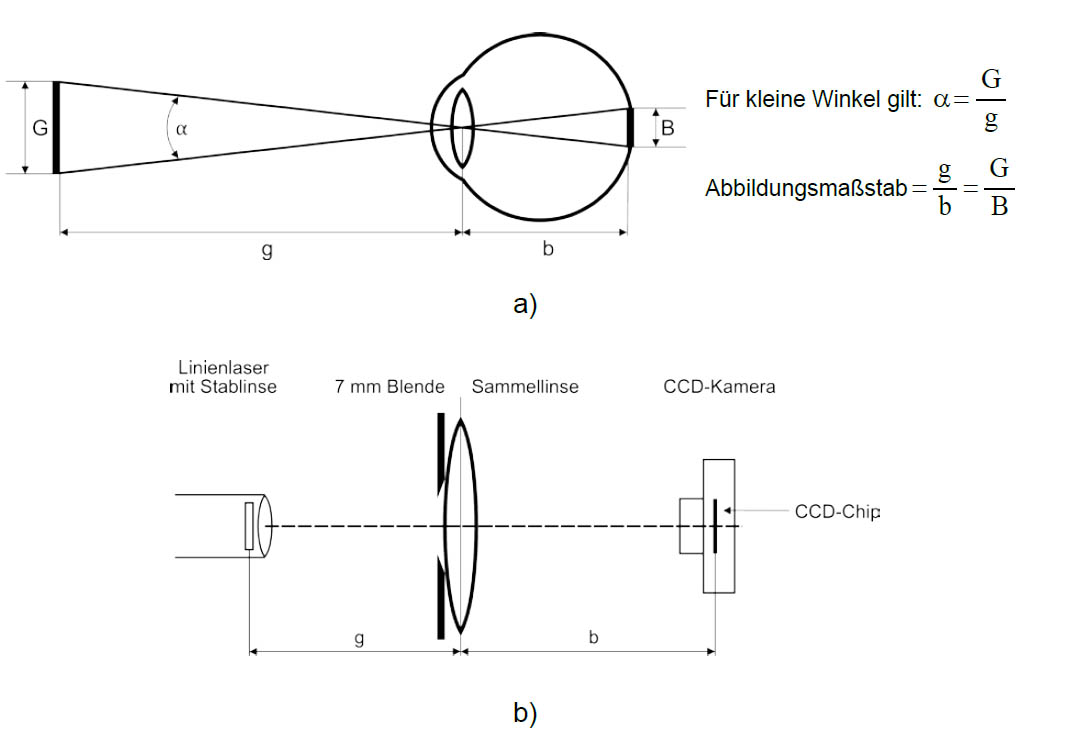
For the sake of simplicity, we use option 2, i.e. calculation based on existing parameters and predefined formulas taken from the TROS.
For laser Class 2, into which we must classify our line laser or the laser system containing a line laser, the maximum permissible laser power is 1 mW, measured at a measuring aperture of 7 mm diameter. For an extended source, we multiply this value by the calculated correction factor and then calculate the required line length at the point of incidence. The point of incidence is the point at which a hazard could first occur.
I can give a short example based on a current project in which we use a 100 mW line laser with an angle of 110°. The calculated and assessed correction factor is 2.34, which means that the maximum permissible exposure power at the measuring aperture must not exceed 2.34 mW. We then divide the laser power by the correction factor and multiply the result by 7 mm, the measuring aperture size, resulting in a minimum line length of 299 mm. From a line length of 299 mm onward, not distance, the laser would therefore be classified as Class 2.
It is also possible to classify a line laser as laser Class 1, as EN 60825-1 provides clear power levels for exposure at the eye. These are 3.9 × 10⁻⁴ W, i.e. a maximum of 0.39 mW. Here, too, the result can be determined by calculation.
Detailed information on safety classification, together with recommendations on minimum distance, is available directly from us. For further information and expert training on the subject of laser safety officers, please contact us.