


14/09/2020
Line Lasers in Machines: Laser Safety & Classification
Using a line laser in a commercial machine is not difficult. Our modules, kits and ready-to-use units make it very easy to add a laser line or another type of visual positioning aid to a workbench, work surface or machine. With different laser colors and a wide range of suitable mounting options, there is a suitable laser unit for almost every application.
Once you have decided to work with our line lasers, one question immediately comes to mind: How do I achieve the required level of laser safety? We certainly do not want to put you, your employees or any visitors at risk, nor do we want anyone to be left uncertain as to whether a potential hazard may exist. If you read my blog, you will already find most of the information you need to understand how safe such a laser can be and how potential hazards can be eliminated. In fact, this is relatively straightforward.
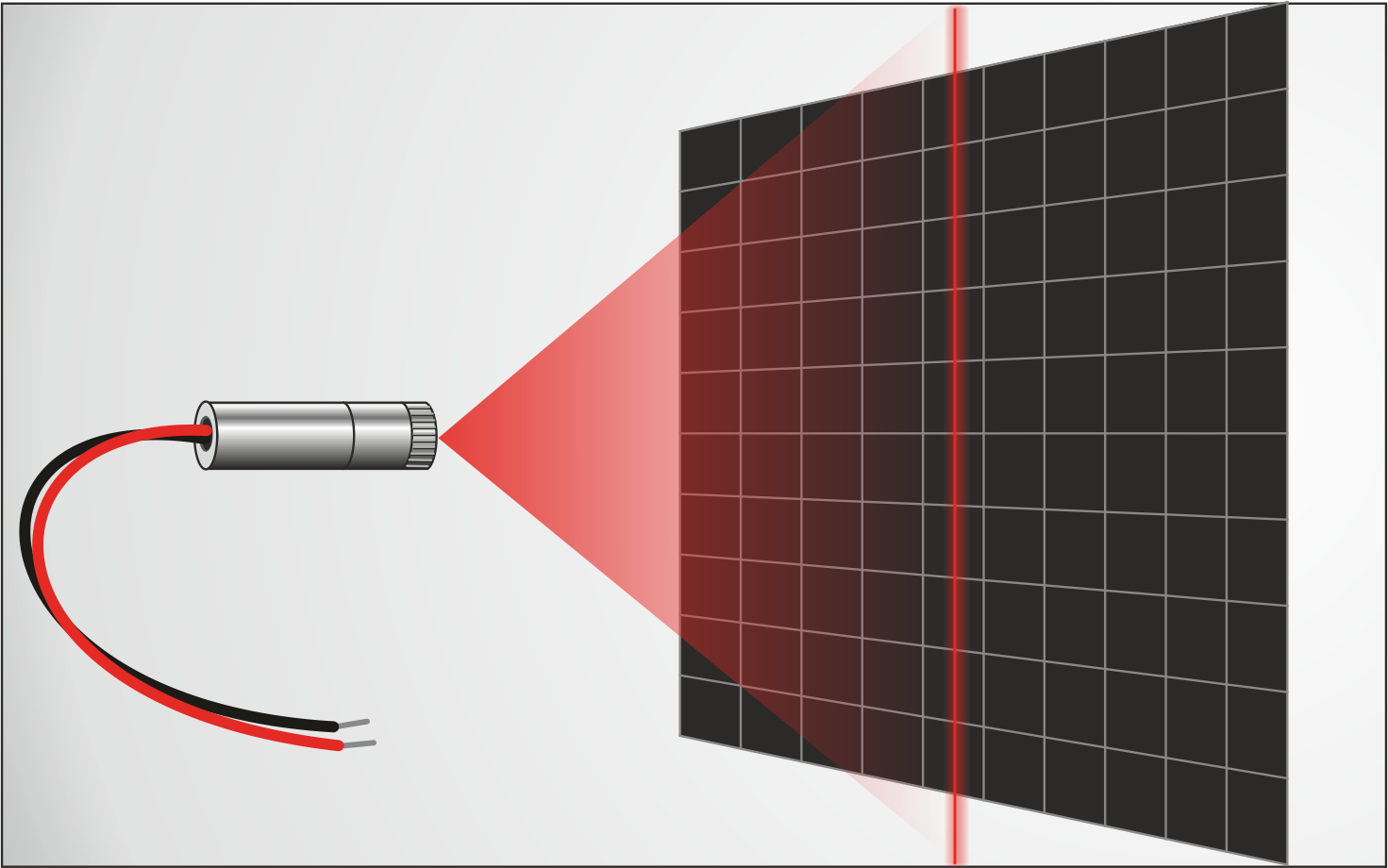
A line laser as a "laser installation"
When assessing laser safety, we basically distinguish between:
- Laser products
- Laser installations
Both naturally include a laser with a certain output power, but they differ significantly in terms of risk assessment and laser classification. While the laser product itself may be classified in various laser classes, typically Class 2, 3R, 3B or 4, the complete laser installation must be designed to achieve Class 2 or even Class 1. Class 1 requires some additional explanation, which I will also address here.
The term "laser product" refers to the device that emits the laser radiation and contains the first point from which the relevant laser radiation exits. In the case of our line lasers, for example, this would be the line-generating optics. After passing through these optics, concentrated laser radiation is emitted, which can undoubtedly present a hazard in almost all cases. If an observer were able to place their eye directly at this laser output aperture, there would be a significant risk of eye injury. This must be prevented.
The term "laser installation" refers to the complete system or assembly in which a laser module, line laser, cross-line laser or even a laser projector is mounted, integrated and operated. A simple example would be a press brake. A laser line is projected onto the sheet metal to indicate the position of the bending edge. In this case, the press brake or machine becomes the "laser installation", because a laser product is mounted on the machine and projects a laser line onto a defined area.
For a risk assessment in accordance with OStrV and EN 60825-1, the complete laser installation must therefore be taken into account, as assessing the laser product alone is not sufficient to determine the actual hazard presented by the installation. When installed correctly, even a 100 mW line laser classified as a Class 3B laser product can become part of a completely safe Class 2 laser installation.
Unfortunately, this assessment method is often not applied correctly, and the safety officer may simply assign a classification based on the output power of the laser product itself. This does not provide an accurate assessment of the complete laser installation.